
xposing Agarwood Counterfeits: Anti-Fraud Guide & Identification Essentials
Author: 菩明沉香 PUMING Agarwood
Release time: 2026-06-15 09:58:43
View number: 16566
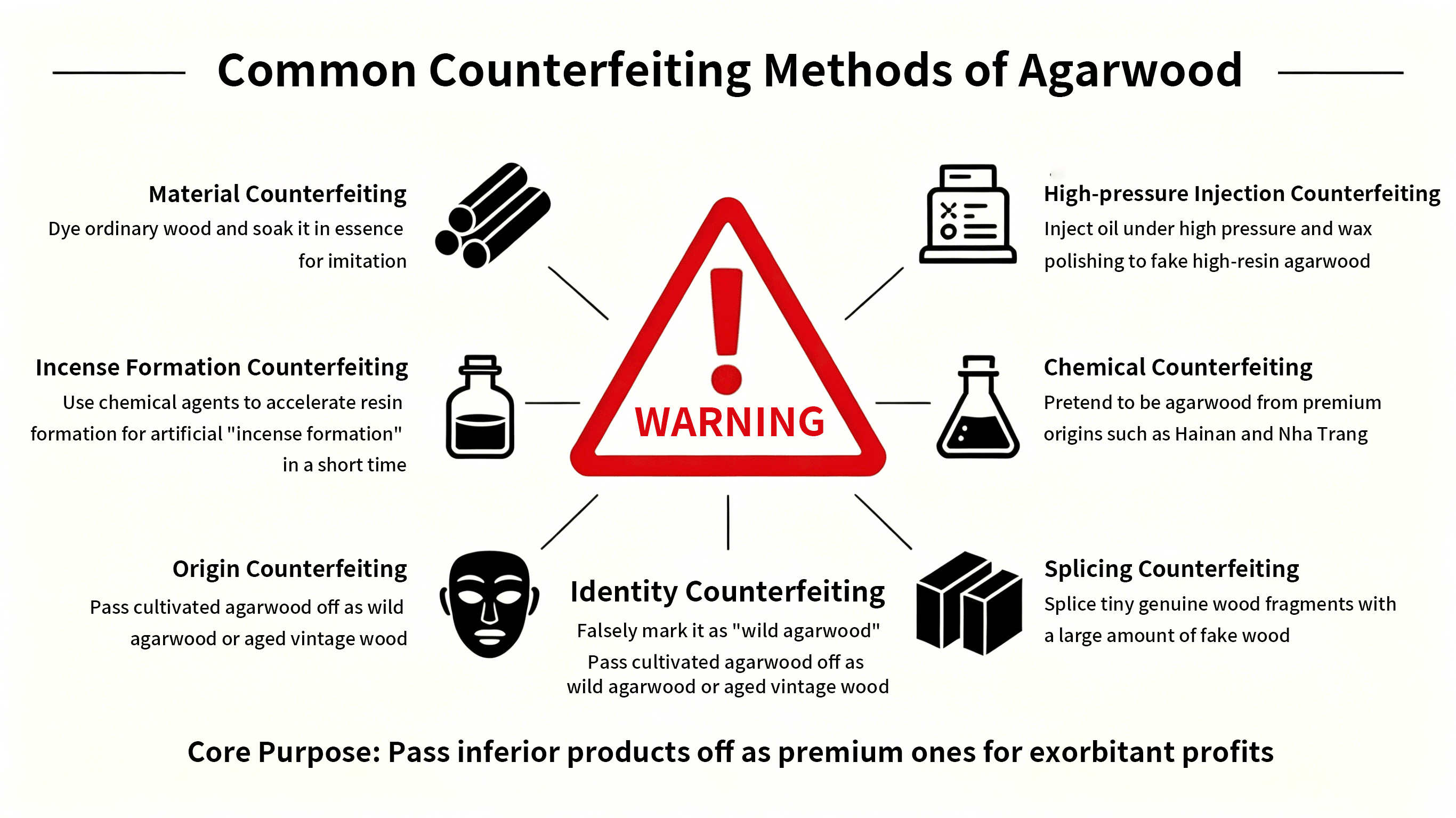
I. Market Background of Agarwood Counterfeiting
In recent years, as the "king of all incense", agarwood is not only a precious spice but also a high-value traditional Chinese medicinal material, leading to a sharp increase in market demand. Nevertheless, wild agarwood takes decades or even centuries to form with an extremely limited annual output. According to the 2023 report of the Southeast Asian Agarwood Trade Association, the annual output of wild agarwood is less than 50 kilograms, while the market circulation exceeds 2000 kilograms, with a counterfeiting rate as high as 92%. The huge supply-demand imbalance and enormous profit margins have prompted unscrupulous merchants to counterfeit products for exorbitant profits. This has resulted in rampant fake and inferior agarwood in the market, seriously disrupting market order and leaving ordinary consumers struggling to distinguish authenticity.
II. Common Agarwood Counterfeiting Methods
1. Chemical Soaking and Dyeing
Some counterfeiters soak and dye inferior ordinary wood, such as non-resinous Puming wood and other miscellaneous wood, in specially prepared chemical potions. After treatment, the wood’s color and texture resemble real agarwood to deceive consumers. However, such fake agarwood lacks the natural charm and subtle fragrance of genuine products, as its scent is chemically generated rather than naturally formed. Long-term wear or use of these chemically treated fake agarwood products may harm human health. Certain chemical agents contain harmful substances that can interfere with normal physiological functions through skin contact or inhalation of volatile fumes.
2. Pressed Molded Fake Agarwood
Unscrupulous sellers mix Puming wood fragments and miscellaneous wood, then press them into blocks or beads with molds and pressure equipment to imitate the appearance of real agarwood. This crude counterfeiting method has obvious flaws upon careful observation. Pressed fake agarwood usually has regular textures without the irregular beauty and layered sense of naturally formed genuine agarwood. Due to the pressing process, its texture is either overly hard or loose with a different hand feel. Moreover, such fake agarwood is generally low-priced, easily deceiving novice consumers who seek bargains.
3. High-pressure Oil Injection Counterfeiting
The core process involves placing aquilaria wood (non-resinous Puming wood) in a high-pressure chamber, injecting mixed grease at 150℃ (70% palm oil, 20% rosin, 10% essence), maintaining 3MPa pressure for 72 hours, and finally carbonizing and aging the surface to simulate genuine agarwood’s grease density and fragrance characteristics. It can be identified through multiple methods: oil accumulates around pores and forms radial oil lines; oil-injected fake agarwood is 15%-25% heavier than natural agarwood of the same volume; obvious decolorization occurs when wiping the surface with alcohol for 10 seconds; when burned, it produces black smoke with a plastic odor, which is vastly different from the light smoke and long-lasting elegant fragrance of real agarwood.
4. Chemical Oil-soaked Agarwood
Merchants soak ordinary wood in artificial essence or synthetic agarwood oil to make the wood absorb oil and emit a scent similar to real agarwood. Such fake agarwood usually has overly bright color and unnaturally uniform grease distribution. It has a strong, single sweet and greasy smell without the rich and varied fragrance layers of natural agarwood. During combustion tests, it produces pungent black smoke. In water immersion tests, an oil film will precipitate when soaked in warm water, which never happens to natural agarwood.
5. Artificially Dyed Agarwood
Some merchants dye or coat ordinary wood with grease to create an "oily and moist" appearance, and even manually draw unique agarwood oil lines to mislead consumers. Typical features include overly uniform oil lines without natural random distribution, unnaturally dark black or brown colors, and color fading after long-term wear. Authentic agarwood has randomly distributed, asymmetrical oil lines. Fake products may fade when wiped by fingers or leave greasy residues on hands, which are effective identification features.
6. "Blessed by Masters" & "Aged Agarwood" Scams
Exploiting consumers’ religious reverence and pursuit of aged agarwood, merchants hype products as "blessed by senior monks" or "century-old aged wood" to raise prices. These overpriced fake products have no traceable authentic information and are accompanied by unsubstantiated legendary stories. In essence, they are ordinary artificially aged wood with unnatural fragrance. Consumers should resist misleading marketing. Agarwood quality is determined by grease content, fragrance changes and resin formation years, not mysterious rumors. Genuine aged agarwood is extremely rare in the market. Products without authoritative appraisal certificates are almost always counterfeits.
7. New Upgraded Counterfeiting Technologies
(1) Genuine Shell & Fake Core Technology
Emerging in 2022, this is a highly concealed counterfeiting method. Counterfeiters wrap an oil-injected wood core with thin natural agarwood slices, making visual identification extremely difficult. Although the outer shell is genuine agarwood, the inner core still has the flaws of high-pressure oil injection. Combustion tests will produce plastic-smelling black smoke, and 3D microscopic CT scanning can detect abnormal internal structural differences.
(2) Biological Ripening Technology
Merchants inject wood-rotting fungi to accelerate grease secretion of wood, attempting to simulate 20 years of natural resin formation within 3 months. Biologically ripened fake agarwood resembles natural agarwood in appearance but differs greatly in fragrance and grease characteristics. Its scent is mellowess and unnatural, with grease distribution and density violating natural growth rules. Professional quantitative analysis of terpenoids by certified institutions can accurately identify such counterfeits.
(3) Nano-level Essence Technology
Microcapsule wrapping technology is adopted to delay essence volatilization, enabling fake agarwood to retain fragrance for a long time. Such nano essence creates natural-like fragrance in the early stage, but its single and non-durable characteristics will emerge over time. The composition and layers of artificial fragrance are fundamentally different from natural agarwood, which can be accurately detected by gas chromatography and other professional tests.
III. Feature Comparison Between Real and Fake Agarwood
1. Grease Distribution Features
Genuine agarwood, especially wild agarwood, has smooth, irregular yet harmonious natural grease lines with cloud-like uneven distribution. In contrast, fake agarwood has unnatural grease distribution: oil-injected products have accumulated radial grease at pores, while chemically soaked or dyed counterfeits have overly uniform grease without layered texture.
2. Fragrance Features
Real agarwood has mild, elegant and diverse fragrances including floral, fruity, milky and honey notes, varying by origin and growing environment. It delivers fresh and sweet cool notes with lingering milky base notes for more than 6 hours. Fake agarwood has pungent, single chemical fragrance that causes irritability and stuffiness after long inhalation. It produces plastic or glue odors when burned with quickly fading scent.
3. Texture Features
Genuine agarwood has clear, natural and vivid textures with intertwined wood and grease layers formed by long-term natural resin formation. Fake agarwood has rigid, overly regular and lifeless textures from artificial drawing or oil pressing, with uniform or gaudy colors and overly smooth or greasy surfaces.
4. Weight and Density Features
Oil-injected fake agarwood is 15%-25% heavier than natural agarwood of the same volume. The density of natural agarwood ranges from 0.98 to 1.15g/cm³, while oil-injected agarwood exceeds 1.25g/cm³. Other counterfeits also have abnormal weight and density due to artificial processing, which can be verified by professional density measuring tools.
5. Microstructural Features
Under a 40x microscope, genuine agarwood shows organic integration of resin ducts and phloem, a unique biological feature of natural resin formation. Fake agarwood presents artificial traces such as disordered fiber structures and injection cavities without natural organic fusion.
IV. Authoritative Identification Methods
1. Sensory Identification
Appearance Observation: Real agarwood is tan, dark brown or black brown with natural irregular layered oil lines or tiger stripes and moist glossy grease parts. Fake agarwood has uniform or gaudy colors, rigid oil lines and overly smooth or greasy surfaces.
Smell Test: Genuine agarwood emits elegant mild fragrance at room temperature, and rich layered sweet, cool, floral or medicinal fragrance when heated. Fake agarwood has pungent chemical essence smell with black smoke and plastic/glue odor after burning, featuring single and short-lived fragrance.
Hand Feel Test: Real agarwood has moist greasy parts and slightly rough wood texture. Fake products are either dry and dull or overly sticky and greasy.
Water Immersion Test: Oil-soaked fake agarwood releases oil film in warm water, while natural agarwood does not.
Combustion Test: Suitable for agarwood sticks and powder. Real agarwood produces light smoke with long-lasting layered fragrance; fake agarwood produces pungent black smoke with chemical odors.
2. Professional Detection Methods
Gas Chromatography: Genuine agarwood contains more than 10% agarotetrol, while oil-injected counterfeits contain phthalate, with a detection accuracy of 99.7%. It can accurately judge authenticity through chemical composition analysis.
Infrared Spectroscopy: Real agarwood has a characteristic peak at 1745cm⁻¹, while oil-injected agarwood has a strong absorption peak at 2920cm⁻¹, with an accuracy of 98.2% for rapid structural identification.
Density Gradient Detection: Natural agarwood density ranges from 0.98 to 1.15g/cm³, while oil-injected agarwood exceeds 1.25g/cm³, with a detection accuracy of 96.5%. For hard-to-identify products, CMA-certified institutions can conduct terpenoid quantitative analysis and 3D microscopic CT scanning for precise identification.
V. Consumer Anti-fraud Suggestions
1. Choose Formal Purchasing Channels
Consumers shall purchase agarwood from qualified and reputable formal merchants or brands with strict procurement and quality control systems to avoid counterfeits. Avoid unlicensed street stalls, small workshops and unsecured online platforms, which have unguaranteed product quality and difficult rights protection after disputes. Most low-cost agarwood from informal channels is counterfeit.
2. Request Authoritative Appraisal Certificates
Ask merchants for appraisal reports issued by authoritative institutions such as the National Gem & Jewelry Testing Center (NGTC). Verify certificate authenticity through official platforms. Be cautious of products without valid authoritative certification.
3. Improve Personal Identification Capabilities
Consumers shall accumulate professional agarwood knowledge through books, tasting events and expert consultations. Offline high-end tasting activities help consumers master practical identification skills and intuitively perceive the unique value of genuine wild agarwood through real and fake product comparison.
4. Treat Prices and Marketing Publicity Rationally
Genuine high-quality agarwood is scarce with stable market prices. Ultra-low-priced products are mostly counterfeits. Resist misleading marketing gimmicks such as "rare collection", "master blessing" and "antique agarwood". Agarwood quality depends on inherent grease content, fragrance layers and resin formation years rather than false marketing stories. Make comprehensive and rational judgments before purchase.